Monday, 9 April 2012

Cesky Krumlov

One of the highlights of my travels through eastern Europe (which comprised of spending two to three weeks traveling through Austria, Hungary, Slovakia, Czech Republic and Poland), was spending a couple of days in the serene and beautiful town of Cesky Krumlov, located in the region of Bohemian, Czech Republic. Unfortunately, like many beautiful old towns in Europe, Cesky Krumlov has become somewhat of a tourist hub, with most tours of the region making a stop here. However, I was fortunate enough to visit Cesky Krumlov during the springtime, as I could imagine that the quaint and quiet atmosphere of the town, which is what made it so appealing to me, would be spoiled by the hoards of summer tourists, flocking to marvel at the town's well preserved baroque architecture or to participate in the numerous outdoor sports available nearby, including white water rafting along the Vltava River or horse riding in the surrounding countryside.


As I walked down the cobble-stoned streets of Cesky Krumlov, I felt as though I was no longer in the 21st century. In the old town centre, there are no tarred roads and no modern architecture to be seen. It seemed as though little had changed in Cesky Krumlov over the past few hundred years, even the pastel coloured, medieval styled residential buildings of the town appear to be well maintained, as though time has stood still.

In the daytime, Cesky Krumlov radiates with colour and life. Locals do their daily shopping in cute little artisan grocery stores, riding bicycles home laden with fresh baguettes and seasonal fruits and vegetables. The streets are full of children playing and small tourist stores display local arts and crafts. But as night falls, the atmosphere in the town drastically changes. Not necessarily in a negative way, the town feels quite safe at night, but once the sun hides its face, there is a somewhat eerie and ghostly feeling about the town, as if it it haunted. The streets are desolate and dimly lit by street lamps. Cats scurry from one dark alley to another, trying to remain the the shadows. The only sounds that can be hear is the faint muffled music from hidden away bars and restaurant, and the rush of the swelling Vltava River. It is little wonder that there are so many ghost stories circulating about the town. http://www.ckrumlov.info/docs/en/mesto_histor_povleg.xml


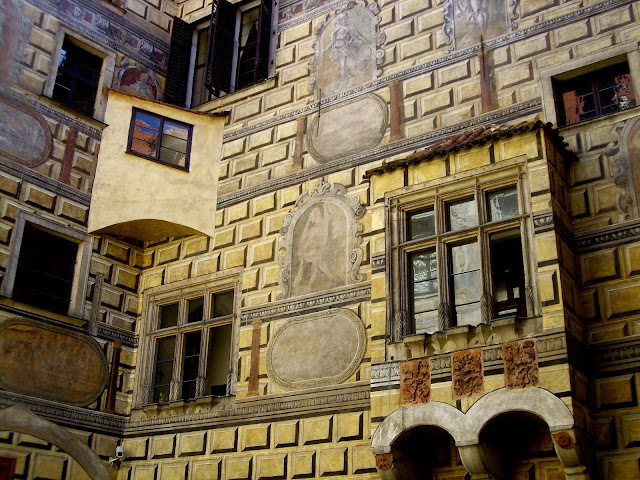
The highlight of Cesky Krumlov, and its claim to fame, is the castle. The castle tower, the most striking monument of Cesky Krumlov, dominates the town's skyscape - making it rather easy to locate the castle complex. Upon nearing the castle, I was rather intrigued by its exterior decoration. What struck me was the use of pastel colours and painted faux architectural features, which are quite graphic, three-dimensional and tactile in form. I am at a complete loss at how to categorise this style of architecture, as I haven't seen anything like it before. However, it makes for an impressive piece de resistance of the town.

Entrance into the castle complex is free, although there are small charges to enter certain parts of the castle, such as the tower for example. The complex is fairly large, boasting many rooms, as well as an expanse of parkland and gardens, including a lake and outdoor theatre, so I'd recommend setting aside two to three hours to see it properly. A note of warning, animal rights activists may have something to say about the bears in the dry moat which surrounds the castle. I'm not quite sure what their purpose of being there is, if bears were kept in this moat in the past, or if its some sort of ploy to attract tourists. Either way, their sparse concrete habitat looks rather stark and depressing.

Some interesting tales and legends about the castle, which I find rather fascinating:
http://www.castle.ckrumlov.cz/docs/en/zamek_oinf_povest.xml




On my final afternoon in Cesky Krumlov, took a little walk into the farmland surrounding the town. I happened to stubble across a path and decided to follow it, passing a number of people who were also enjoying the spring sunshine. As the originally well defined path slowly faded into tuffs of grass and gravel, and then into open grassland, I spotted a little chapel on a hill, and decided to cut across the nearby meadow to reach it. Once I reach the peak, I was greeted a spectacular view onto the town below (the chapel can be see in the photograph above, in the center of the horizon line, surrounded by trees). Although it was an exhausting hike, climbing over stone walls and pushing through trees and shrubs, not to mention the incline of the hill, like most things which require a great deal of effort, the reward (the view) at the end was worth it.


During my stay in Cesky Krumlov, I stayed at Hostel 99, which is located at the entrance of the old town, as you cross the bridge near the main bus stop. It is a converted and beautifully preserved 14th century building, with cellar like rooms downs stair, boasting thick stone wall and beautiful arches. The attic rooms are just as impressive, with distressed timber floor and exposed timber ceiling beams. I remember the hostel owner mentioning that the building once housed a hospital and lunatic asylum, which sent a bit of a chill up the spines of a few of my fellow travellers, as well as provoking a number of ghost stories after the lights went out. However, it was one of the most comfortable, pleasant and interesting hostels I've stayed in. 

Friday, 9 September 2011

Verrocchio Arts Centre, Tuscany

An amazing view from my bedroom window
Tucked away amongst the rolling green hills of Tuscany is the little known town of Casole d'Elsa. I spent two weeks there in 2007 attending classes at Verrocchio Arts Centre. It was an unforgettable two weeks spent painting, drawing, sculpting, enjoying amazing food (thanks to our in-house chef) and idly soaking in the fresh air and undulating hills of Tuscany.

Casole d'Else is a typical Tuscan hilltop town, which overlooks the surrounding, picture-perfect countryside. Like many rural town, it isn't the easiest place to access - it look me almost 24 hours from Split, Croatia. It consisted of an overnight boat to Ancona, three trains, two buses and one long uphill walk! Despite the small size of the town, which cannot be home to more than a few hundred people if that, I even had difficulty locating Verrochio Arts Centre in the labyrinth of streets and walkways.
 

Everyday at Verrochio Arts Centre would commence in much the same way. We'd wake up to the sound of the church bells tolling seven o'clock and by eight o'clock our delicious breakfast was served on the vine-covered terrace overlooking the landscape beyond. Classes began at 9am sharp in the studio and continued until 12 noon. At 1pm an equally amazing lunch was laid out on the communal table (usually creative prepared from leftovers from the previous night) and then we took a siesta until 3pm when classes recommenced. Classes ended for the day at around 6pm, which gave us enough time to get ready for dinner at 7:30pm. Each night dinner consisted of a delicious three-course meal and the dessert was always scrumptious (I'm a self-confessed sugar addict). I almost enjoyed the food more than anything else during these two weeks. Dinner was always followed by an engaging and lively discussion about politics, philosophy, art, the state of the world in general (it was a group of about ten artists, could you expect any different?). In short, two weeks of bliss!

We also had a few free days during which we walked throught the surrounding countryside, exploring nearby churches, farms, Etruscan archeological sites and a few of the nearby towns. I was fortunate to be there during a festival which was held one evening in the plaza beneath the Arts Centre. We joined in with some of the extremely friendly local people, for an evening of eating, drinking, singing and dancing under the stars into the early hours of the morning.

A misty morning looking over the terrace


Julie's watercolours

Maria's House


Cats of Casole d'Elsa


Monday, 25 July 2011

Monschau, Germany


This obscure small town on the Belgium/Germany boarder is up there as one of my favourite places in Europe. Thanks to my cousin, who is incredibly knowledgeable about about places to see and things to do in Northern Europe (he would have made a great tourist guide, it's a shame he didn't take that career path), I saw many things and places in Belgium, Germany and The Netherlands which I had no intention of seeing, let alone having any knowledge of, but in the end was completely amazed by. During our little road trips, he constantly pointed out places of interest (there's so and so church, there's that cathedral, there's an amazing gallery), explaining the history of a monument or town (that is dedicated to so and so, this event happened here, so and so visited this town on this particular date), and he was excited to take me me to little-known, yet amazing and stunning towns (including Monschau, Leuve, Aachen and Maastricht), which the average tourist would have completely passed by, utterly unaware of what they had missed out on. 


Monschau is situated in Germany, only 2km from the Belgium boarder. The town was originally known as Montjoie (being a French/Belgium word), as it was under French rule from 1795. The name of the town was altered in 1918, when the town was awarded to Prussia, and until today it is known as Monschau. The towns cobbled streets and timber framed houses have change very little over the last 300 years. The town was extremely lucky to escape air-raid bombings during the Second War World, and as a result, is it one of the few towns in the region to be almost completely preserved.


Driving through the Belgium countryside one morning, I was completely unaware about where we were going as we crossed the German boarder - Jean-Marie tended to just drive, as though he made the decision about where we were going on the way there. Even when we entered the hills of North Eifel and began to descend the long winding road down into the valley where Monschau is situated, I had little idea about the uniqueness of the town which we were about to visit. As you cross the bridge from the parking bays, you being to feel as though you have stepped back into time, or are living some sort of Disney fairytale. The town feels somewhat empty and eerie as you walk through the narrow grey cobblestone streets (these streets are only for pedestrians as there is no access for cars - I'm sure the town planners three centuries ago did not envisions cars zooming down these picturesque streets), almost as though you are in a movie set for a film such as Tim Burton's Sleepy Hollow (that's it, Monschau has a Burton-ish feel to it - eerie, peculiar and magical, especially on a grey overcast autumn day, such as the one when we visited the town - I'm sure it would have completely different atmosphere if you visited on a warm and sunny spring day).

If you take a walk up to the ruins of the 13th century Monschau castle, once the seat of the powerful Counts of Julich until it was besieged by Emperor Charles V in 1543, you are afforded with a spectacular view of the surrounding hills and the isolated town in the valley below. Once there, imagine if you were to place an empty gilded frame in front this landscape, it would be easy to mistake the pointed grey rooftops and church spires, set against the lush green foliage of the encircling forest, as an oil painting from the Danube School - it's almost that idealistic.

If you're in Germany or Belgium, or any other part of Europe, or the world for that matter, take time out to diverge from the regular tourist route and you might be surprised at what hidden gems you might discover. (It also helps to have the assistance and knowledge of a local).


Sunday, 17 July 2011

Belgium


Luvern

Beer + Waffles + Chocolate = Belgium. And it's also the headquarters of the European Union. I guess this is what usually comes to mind when someone mentions Belgium. The small northern European country that is usually forgotten about by most western European tour operators, due to its small size and lack of famous monuments and crowd eliciting festivals. People go to France for the Eiffle Tower, Cannes, the Louvre; Italy for the Colusseum, Venice, Tuscany; Germany for Octoberfest and Berlin; Spain for the running of the bulls, Gaudi...but to go to Belgium just for some chocolate and waffles? Despite its humble exterior, Belgium is a culturally and historically rich country, with amazing architecture, picture perfect towns and breathtaking scenery.


Brussels


Originally I wasn't terribly keen/overly excited to visit Belgium, other than being eager to visit two of my grandfather's sisters and my cousin Jean-Marie, whom I had never met before. So taking the train from le Gard du Nord in Paris, with my great masses of luggage (I always have the best intentions of packing light, but I always seem to go overboard, especially this time as I had to pack for all seasons since I had planned to be in Europe for a minimum of six months), I made my way to Liege, Belgium, not having any prior conceptions of what to expect. During my travels I found that that I was usually somewhat disappointed by places which had been overly hyped-up, and pleasantly surprised when visiting places with no prior expectations - and Belgium was one of the latter.

The meeting point of Belgium, Germany and the Netherlands
First World War cemetery

I was lucky to have a private chauffeur driven service whilst in Belgium, many thanks to Jean-Marie, who took a week off work to show me around a number of towns, cities and the Belgium countryside (he was a fantastic tour guide, as he is highly knowledgeable about almost every aspect of the history and culture of Belgium - also having travelled around the country a great deal, he knew all the most worthwhile places to visit). And I was also so fortunate as to be staying just outside the unusual and intriguing city of Liege. At first sight, Liege appeared to be a very dull and grey city, due to its coal mining origins. However, its warm and inviting atmosphere quickly overrode my initial negative impressions. Sunfilled Sunday afternoons are particularly beautiful in Liege, with families leisurely strolling through the city centre whilst you're soaking in the sun in one of the many outdoor cafes.

Brodosplit - A Dalmatian Klapa performing in Brussels

We spent the next week visiting numerous places around Belgium, including Brussels, Luvern, Aachen (including the exact spot where Belgium, the Netherlands and Germany meet), Monschau, Ghent and Bruges (I was so amazed by the final three towns that deserve their own post on this blog). If you enjoy admiring beautiful scenery, visiting interesting towns and eating chocolate and waffles, I'd definitely take a detour through Belgium, if only for a few days, when you're next in Europe.


Liege


Teta Antica's little house